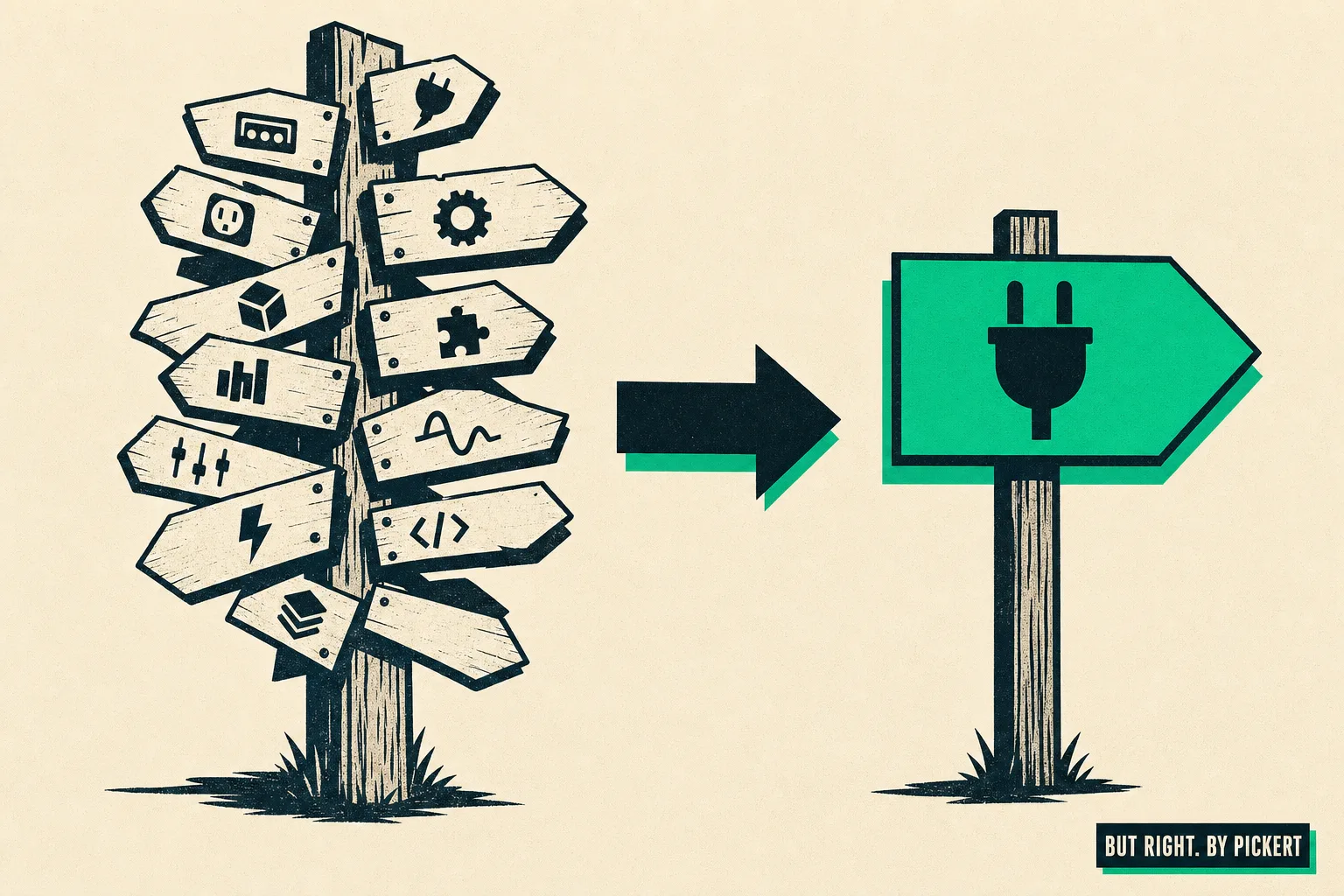
Vibe coding for your company website: where Lovable & Co. reach their limits

You have probably played around with Lovable, Bolt or v0 already. Type in a few sentences, and ten minutes later there is a website that looks really good at first glance. That is exactly what makes vibe coding so tempting, especially for founders and small teams without their own development department.
The only question is: is that enough for your company's website? And what happens when, six months from now, you need a booking system, a second language or a newsletter?
In this article we take an honest look at what vibe-coding tools are really good for, where their limits are and what you should watch out for before building your company website on them.
What vibe-coding tools like Lovable, Bolt and v0 actually are
At its core, vibe coding is simple. You describe in plain language what you want, and an AI model writes the code for it.
The term comes from the developer scene. It refers to the feeling of "vibing" your way through a project instead of typing every line yourself.
The term was coined in 2025 by the AI researcher Andrej Karpathy, previously at Tesla and OpenAI among others. He used it to describe exactly this kind of programming in the flow, where you trust the AI and rarely look at the generated code.
Tools like Lovable from Stockholm, Bolt.new from StackBlitz or v0 from Vercel have made this approach accessible for websites and small web apps. You write a prompt, get a working page and keep changing it via chat.
For many people, this is their first hands-on contact with a website at all, without an agency and without developers. No wonder these tools became so popular so quickly.
What vibe-coding tools are really good for
Before we talk about limits: these tools deserve their reputation. For certain tasks they are unbeatably fast.
What they are really suited for in practice:
- A landing page for a pitch, an event or a quick test
- A prototype that makes an idea visible before real money goes into development
- An internal tool where speed matters more than robustness
- A first step, if you simply want to understand how a website is built in the first place
For these purposes, vibe coding is often the smarter choice than classic website development. Why wait three weeks for an agency when you need a result in an hour that is only meant to be tested?
The moment it gets complicated
As one of our developers recently put it: of course vibe-coding tools let you build a website very quickly that looks good, too. But the problems start as soon as you get into the details.
The detail is usually not the design. These tools have become astonishingly good at design.
The detail is everything below the surface: hosting, maintenance, security, extensibility. Exactly the things a founder rarely thinks about with the first prompt.
Have you ever looked at where your AI-built website actually runs, and who is responsible for it if something goes wrong?
No production-ready infrastructure under the hood
A website that looks good in the editor is not yet a website that runs production-ready. That is the first blind spot of many vibe-coding results.
Production-ready means: backups are set up, errors are monitored, and the site can handle a rush of visitors without going offline. Most quickly generated projects have none of that.
You do not notice it on launch day. You notice it when the site goes down one day and nobody knows why.
Hosting and data security: open questions
Where exactly does your website run? In many vibe-coding projects this is not clearly documented but hidden somewhere in the tool's default settings.
That becomes a problem at the latest when customer data is involved. A contact form, a newsletter sign-up form, maybe even payment details: where does this information end up, and who could theoretically access it?
For a company based in Germany, that is not a side issue. It is about GDPR obligations that do not disappear just because an AI wrote the code.
Maintenance: who actually patches the holes?
Every piece of software has dependencies. Libraries, frameworks, small building blocks that constantly need updating, because otherwise security holes stay open.
With a classically developed website, there is a structure for that: someone is responsible, and updates run regularly. With a site generated from a prompt, that structure usually does not exist.
The site runs today. Whether it still runs cleanly in a year depends on whether anyone is looking at all.
Credentials: who has access to what?
API keys, hosting logins, admin accounts. Credentials pile up in every vibe-coding project, often faster than you think.
Typical questions that stay open in practice:
- Who besides you knows the password for the hosting account?
- What happens to the logins when a team member leaves the company?
- Are API keys lying around openly in the code instead of being stored securely?
- Is there even a list of who has access to what?
These questions sound like trivia. They only get loud when something goes wrong and nobody can get in any more.
How to tell you have reached the limit
This limit rarely announces itself. It shows up in small, annoying moments that keep piling up.
There are a few typical signals that a vibe-coding project is reaching its limits:
- Every small change suddenly takes longer than it did with the first prototype
- The chat history with the AI tool is getting longer than the actual website
- Nobody on the team dares to make bigger adjustments themselves any more
- A function you want simply cannot be built in cleanly, no matter how the prompt is worded
- The site's loading time or stability becomes a topic in customer conversations
Does one of these sound familiar? Then you are not alone. That is the point at which many founders realise that "built quickly" and "sustainable in the long run" are two different things.
The practical test: what happens when a new function is added?
The most honest test for any website is not launch day. It is the day a new requirement comes in.
Adding a booking system
A hairdresser, a consultant, a studio: at some point, people should be able to book an appointment online. That sounds like a small addition.
In reality, a booking system needs a database, calendar logic and often a payment connection. On a vibe-coding foundation, that usually means starting over rather than simply extending.
Forms and search
A contact form is usually still doable. A site search across hundreds of subpages, a wiki section or a member login are a different category.
This is where it shows whether there is a real structure under the website or just a collection of generated individual pages.
A search across a hundred pages needs an index that grows automatically with new content. Hand-clicked vibe-coding pages usually lack this groundwork entirely, because nobody ever planned for it.
Newsletter, shop and multiple languages
A newsletter form with double opt-in. A small online shop with real orders. A second language version that is not just translated but can also be maintained separately.
Each of these functions on its own is normal for a company website. Together, they are the reason why many vibe-coding projects eventually have to be rebuilt completely instead of just being extended.
How often have you heard: "We'll add that later"? On a solid foundation, that is a booking. On a pure vibe-coding structure, it is often a restart.
What really makes a website extensible
Extensibility is not a marketing word; it can be pinned down to concrete things. A website is really extensible when:
- It has its own CMS through which content and media can be maintained without a developer
- New pages or language versions can be added without tearing apart the existing structure
- Functions such as search, chatbot, newsletter, member area or shop can be added later as modules
- The technical foundation (the tech stack) stands on a widespread, well-maintained base instead of a black box
- It is clearly documented who has access to hosting, domain and credentials
These are exactly the points that separate a quick prototype from a website a company can actually grow with.
An example from practice
We accompanied a project ourselves that took exactly this path: from a vibe-coding platform to a solid, multilingual foundation. "Rocket Routine" was about a content migration and a clean rebuild in several languages, without starting from zero.
The original prototype had done its job well. It had shown what the site should look like and which content was needed.
For long-term operation, it still needed a different foundation afterwards. That is not an exception but a pattern we see more often.
Content had to be carried over without getting lost. Several language versions had to be maintainable cleanly, not just translated once. The end result was a website that keeps running instead of being rebuilt from scratch with the next wish.
Thinking about SEO and AI search systems from the start
Today a company website is not only read by Google. ChatGPT, Perplexity and similar systems now search and quote websites just as much.
That takes more than a pretty design: a clean structure, structured data, clear answers in the text and, ideally, an llms.txt file that helps AI systems classify a site's content correctly.
On a quickly clicked-together vibe-coding site this is rarely considered, simply because nobody asks for it in the first prompt. On a website structured cleanly from the ground up, it is part of the foundation.
Are you wondering right now whether your own website is even built to be readable for AI search systems? A quick look at the source code often gives you the answer.
Fast and professional: no contradiction
The honest answer to the question "vibe coding or professional website" is: it depends on what comes next. For a test, vibe coding is often completely sufficient.
For the website a company uses to present itself for the long term, win customers and at some point add a booking system or a shop, a solid foundation is the better starting point. Not because vibe coding is bad, but because the two tools are built for different jobs.
The good news: fast and professional are not mutually exclusive. There are now ways to set up a website at a comparable pace without giving up structure, your own CMS and later extensibility.
The difference rarely lies in the speed on day one. It lies in what can still be adjusted on day thirty without anyone having to start over.
Costs: fast does not automatically mean cheap
Starting with a vibe-coding tool feels cheap, sometimes even free for the first attempts. That is true, too, for a pure prototype.
The real costs show up later. Namely when the site has to be rebuilt completely because a booking system or a shop can no longer be integrated cleanly.
Starting over a second time is more expensive than starting with an extensible foundation right away. You can see that in every project that had to be built twice: once fast, once right.
Conclusion: what does this mean for your decision?
Vibe-coding tools are good for tests, prototypes and the first quick impression. For a company website that is meant to grow with you, the structure underneath is often missing: hosting, maintenance, credentials, real extensibility.
So what do you really need: a quick prototype for tomorrow, or a foundation that can still take a booking system, a shop or a second language a year from now?
For exactly this question there is now a third way between "slow agency" and "vibe coding without structure". websites. but-right. builds a professional website foundation at a pace comparable to an AI tool, but with its own CMS, a modern tech stack and modules such as a booking system, shop or multiple languages that can simply be added later. If you want to see what that looks like in practice, you will find the next step there.